



Designed as a foundation for students wishing to pursue further studies in Islamic disciplines — or simply to gain proficiency in classical Arabic — this programme focuses on the language of the Qur’an and the classical scholarly tradition, rather than the Modern Standard Arabic used in contemporary contexts. No prior knowledge of Arabic is required.
Through systematic study of grammar (naḥw and ṣarf), vocabulary, reading, and comprehension, students develop the core skills needed to access primary sources and engage independently with the classical Islamic heritage.
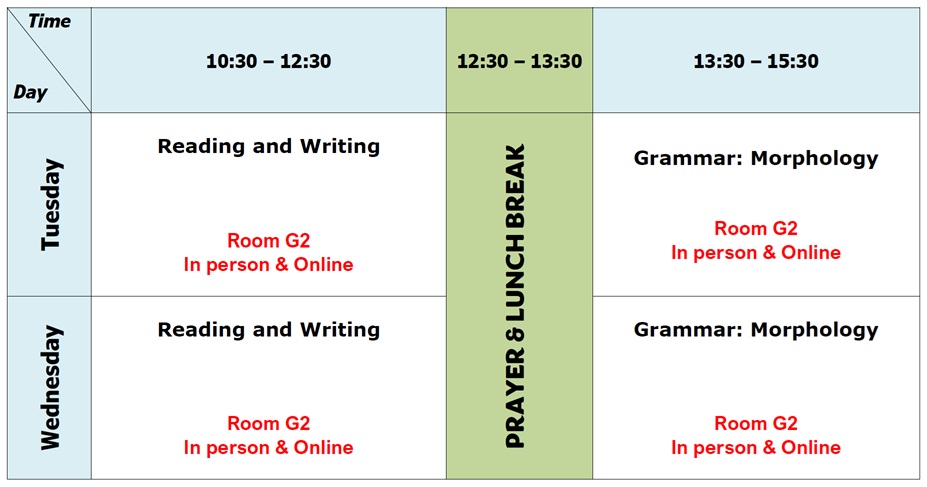
The complete course is divided into three parts, each comprising 12 sessions held twice per week.
Part 1 — Reading and Writing & Morphology. An introduction to Arabic script and word patterns, exploring how Arabic words are formed and change.
Part 2 — Listening and Speaking and Syntax. A focus on correct sentence construction alongside the development of listening and reading skills.
Part 3 — Qur’anic Recitation & Analytical Grammar. Applied reading of Qur’anic texts with deeper engagement in grammatical analysis.
This course focuses on the Arabic language. The course dives deep into classical Arabic vocabulary and basic grammar rules. It’s designed to provide a solid foundation of the most common vocabulary and will enable you to go through daily life, navigate a variety of situations, and have significant conversations with speakers of Arabic.
Book One of Al-Arabiyyah Bayna Yadayk. Each session is designed to develop the four core language skills (listening, speaking, reading, writing) with a focus on practical application through dialogues and interactive exercises.
Reading & Writing Module
1. Greetings & Introduction
Learn to write the Orphan Letters individually and within words.
Learn Arabic cardinal numbers (1–5).
Learn Arabic question words: هل، كيف، ما and demonstrative pronouns: هذا، هذه, and use them in sentences.
Learn vocabulary related to the unit and apply it in sentences.
Practice reading, matching questions with sentences, and reading comprehension.
2. Family
Learn to write the Boat-Shaped Letters individually and within words.
Learn Arabic cardinal numbers (6–10).
Learn Arabic question words: مَن، أين and use them in sentences.
Learn vocabulary related to the unit and apply it in sentences.
Practice reading, matching questions with sentences, and reading comprehension.
3. Home / Living
Learn to write the Trailing-Tailed Letters individually and within words.
Learn the days of the week in Arabic.
Learn Arabic question words: ماذا، كم and use them in sentences.
Learn vocabulary related to the unit and apply it in sentences.
Practice reading, matching questions with sentences, and reading comprehension.
4. Daily Life
Learn to write the U-Shaped Letters (Part 1) individually and within words.
Learn Arabic ordinal numbers (1st–5th) in the masculine form.
Learn the Arabic question word متى and use it in sentences.
Learn vocabulary related to the unit and apply it in sentences.
Practice reading paragraphs and comprehension exercises.
5. Food & Drinks
Learn to write the U-Shaped Letters (Part 2) individually and within words.
Learn Arabic ordinal numbers (1st–5th) in the feminine form.
Practice answering questions using Yes and No responses.
Learn vocabulary related to the unit and apply it in sentences.
Practice reading paragraphs and comprehension exercises.
6. Prayer
Learn to write the letters ه / ة and ي / ى, and distinguish between them in writing.
Learn Arabic ordinal numbers (6th–10th) in the masculine form.
Learn the Arabic question word لماذا and use it in sentences.
Learn vocabulary related to the unit and apply it in sentences.
Practice reading paragraphs and comprehension exercises.
7. Work
Learn about time expressions (الوقت) including morning, afternoon, and evening.
Learn Arabic ordinal numbers (6th–10th) in the feminine form.
Learn to form questions using هل + فعل مضارع.
Learn vocabulary related to professions (المهن), workplaces (مكان العمل), and working hours (ساعات العمل), and use them in sentences.
Practice reading paragraphs and comprehension exercises.
8. Shopping
Learn to form questions using what, which, and how much, and respond appropriately.
Learn Arabic numbers (10, 20, …, 100).
Learn the names of colours (masculine forms) and use them in sentences.
Learn vocabulary related to the unit and apply it in sentences.
Practice reading paragraphs and comprehension exercises.
9. Weather
Learn adverbs and their opposites, and use them in sentences.
Learn the names of the:
Four seasons
Weather-related adjectives
Adverbs of place
Practice writing questions and answers using the question words كم، كيف، متى.
Learn vocabulary related to the unit and apply it in sentences.
Practice reading paragraphs and comprehension exercises.
10. Travel
Learn the plural forms of words.
Learn how to negate sentences using the particle لا.
Learn the four directions and use them in sentences.
Learn vocabulary related to the unit and apply it in sentences.
Practice reading paragraphs and comprehension exercises.
11 and 12. Portfolio and final exam
Morphology
• What is ṣarf?
• What is a kalimah (word)?
• Three types of words: verbs, nouns, particles
• Signs of a verb, noun, and particle
• Root letters (الحروف الأصلية) and extras
• Word patterns (الميزان الصرفي)
• Sound and unsound words
• Past tense verbs (الفعل الماضي): their meanings and conjugation
• The present tense (الفعل المضارع), its differences from the past verb, and its conjugation.
• The imperative (فعل الأمر): What is the command form, and how to derive it from the present tense
• The active & passive verb (المعلوم والمجهول); how to form a passive verb from past, present and imperative
Modules offered: Part 1 – Reading, Writing & Morphology
Entry requirement: No prior knowledge of Arabic required
Duration: 12 weeks per part (36 weeks for all three parts)
Fees: £ 125 for Reading & Writing, £125 for Morphology, or £200 for both modules
Location: In-person and online
Part 1 start date: 30 June 2026
Questions? Contact The Islamic College at admissions@islamic-college.ac.uk
or +44 (0) 208 451 9993, ext. 206